You looked down
From Your Cross
To behold faithfulness.
There stood Your Mother.
You beheld her look of grief,
Her suffering Your pain.
You wed it
To Your Own,
Presenting all
Before Our Father’s holy throne.
© 2013 Joann Nelander

You looked down
From Your Cross
To behold faithfulness.
There stood Your Mother.
You beheld her look of grief,
Her suffering Your pain.
You wed it
To Your Own,
Presenting all
Before Our Father’s holy throne.
© 2013 Joann Nelander
via Family synod: full text of Pope Francis’s homily at opening Mass | CatholicHerald.co.uk.
Today the Prophet Isaiah and the Gospel employ the image of the Lord’s vineyard. The Lord’s vineyard is his “dream”, the plan which he nurtures with all his love, like a farmer who cares for his vineyard. Vines are plants which need much care!
God’s “dream” is his people. He planted it and nurtured it with patient and faithful love, so that it can become a holy people, a people which brings forth abundant fruits of justice.
But in both the ancient prophecy and in Jesus’s parable, God’s dream is thwarted. Isaiah says that the vine which he so loved and nurtured has yielded “wild grapes” (5:2,4); God “expected justice but saw bloodshed, righteousness, but only a cry of distress” (v7). In the Gospel, it is the farmers themselves who ruin the Lord’s plan: they fail to do their job but think only of their own interests.
In Jesus’s parable, he is addressing the chief priests and the elders of the people, in other words the “experts”, the managers. To them in a particular way God entrusted his “dream”, his people, for them to nurture, tend and protect from the animals of the field. This is the job of leaders: to nuture the vineyard with freedom, creativity and hard work.
But Jesus tells us that those farmers took over the vineyard. Out of greed and pride they want to do with it as they will, and so they prevent God from realizing his dream for the people he has chosen.
The temptation to greed is ever present. We encounter it also in the great prophecy of Ezekiel on the shepherds, which St Augustine commented upon in one his celebrated sermons which we have just reread in the Liturgy of the Hours. Greed for money and power. And to satisfy this greed, evil pastors lay intolerable burdens on the shoulders of others, which they themselves do not lift a finger to move.
We too, in the synod of bishops, are called to work for the Lord’s vineyard. Synod assemblies are not meant to discuss beautiful and clever ideas, or to see who is more intelligent… They are meant to better nuture and tend the Lord’s vineyard, to help realise his dream, his loving plan for his people. In this case the Lord is asking us to care for the family, which has been from the beginning an integral part of his loving plan for humanity.
We are all sinners and can also be tempted to “take over” the vineyard, because of that greed which is always present in us human beings. God’s dream always clashes with the hypocrisy of some of his servants. We can “thwart” God’s dream if we fail to let ourselves be guided by the Holy Spirit. The Spirit gives us that wisdom which surpasses knowledge, and enables us to work generously with authentic freedom and humble creativity.
My Synod brothers, to do a good job of nurturing and tending the vineyard, our hearts and our minds must be kept in Jesus Christ by “the peace of God which passes all understanding” (Phil 4:7). In this way our thoughts and plans will correspond to God’s dream: to form a holy people who are his own and produce the fruits of the kingdom of God.
via Family synod: full text of Pope Francis’s homily at opening Mass | CatholicHerald.co.uk.
Thomas wanted reality.
Thomas wanted answers.
Thomas wanted undeniable proof.
He trusted his mind.
He trusted his senses.
He walked by sight,
But feared to trust
The witnesses of Resurrection.
A God, with wounds of Love, understood.
A God, marked by our disbelief,
Stood before him,
In plain sight.
Thomas finger my wounds.
Feel the warmth of human flesh.
Feel the throbbing of My Heart,
Bounding against
Your hand in My Side.
Thomas, you sought only
The trappings of reality.
Am I real now,
Real enough for you,
My friend?
Standing, face to face,
Before I Am,
Bought to his knees
By living, breathing, proof,
He stands in our place.
Humbled by faith’s awakening,
Before the True Witness,
Senses satisfied,
Content, now, and forever,
He’ll follow blindly,
Unto death,
Into eternity.
“My Lord and my God.”
Copyright Joann Nelander 2012
All rights reserved
The movie “Left Behind” opens today. And while, in a secular culture dismissive of any consequences for unbelief, we can rejoice in any salutary reminders, it is unfortunate that the reminder is riddled with questionable theology and dubious biblical interpretation.
In certain (but not all) Protestant circles, and especially among the Evangelicals, there is a strong and often vivid preoccupation with signs of the Second Coming of Christ. Many of the notions that get expressed are either erroneous or extreme. Some of these erroneous notions are rooted in a misunderstanding of the various scriptural genres. Some are rooted in reading certain Scriptures in isolation from the wider context of the whole of Scripture. And some are rooted in reading one text and disregarding others that balance it.
The Catholic approach to the end times (eschatology) is perhaps less thrilling and provocative. It does not generate “Left Behind” movie series or cause people to sell their houses and gather on hillsides waiting for the announced end. It is more methodical and seeks to balance a lot of notions that often hold certain truths in tension.
I thought it perhaps a worthy goal to set forth certain principles of eschatology from a Catholic point of view, since the movie “Left Behind” is bound to generate questions among fellow Catholics. Most of the teachings offered in this post are drawn straight from the Catechism and the Scriptures. What I offer here I do not propose to call a complete eschatology, only a sketch of basic principles rooted right in the Catechism of the Catholic Church,,,,,,,,,,,,,,read more. via Archdiocese of Washington
…”During the Middle Ages you could not find a Christian in Europe who did not believe that the Crusades were an act of highest good. Even the Muslims respected the ideals of the Crusades and the piety of the men who fought them. But that all changed with the Protestant Reformation. For Martin Luther, who had already jettisoned the Christian doctrines of papal authority and indulgences, the Crusades were nothing more than a ploy by a power-hungry papacy. Indeed, he argued that to fight the Muslims was to fight Christ himself, for it was he who had sent the Turks to punish Christendom for its faithlessness. When Sultan Suleiman the Magnificent and his armies began to invade Austria, Luther changed his mind about the need to fight, but he stuck to his condemnation of the Crusades. During the next two centuries people tended to view the Crusades through a confessional lens: Protestants demonized them, Catholics extolled them. As for Suleiman and his successors, they were just glad to be rid of them.
It was in the Enlightenment of the eighteenth century that the current view of the Crusades was born. Most of the philosophes, like Voltaire, believed that medieval Christianity was a vile superstition. For them the Crusades were a migration of barbarians led by fanaticism, greed, and lust. Since then, the Enlightenment take on the Crusades has gone in and out of fashion. The Crusades received good press as wars of nobility (although not religion) during the Romantic period and the early twentieth century. After the Second World War, however, opinion again turned decisively against the Crusades. In the wake of Hitler, Mussolini, and Stalin, historians found war of ideology–any ideology –distasteful. This sentiment was summed up by Sir Steven Runciman in his three-volume work, A History of the Crusades (1951-54). For Runciman, the Crusades were morally repugnant acts of intolerance in the name of God. The medieval men who took the cross and marched to the Middle East were either cynically evil, rapaciously greedy, or naively gullible. This beautifully written history soon became the standard. Almost single-handedly Runciman managed to define the modern popular view of the Crusades.
Since the 1970s the Crusades have attracted many hundreds of scholars who have meticulously poked, prodded, and examined them. As a result, much more is known about Christianity’s holy wars than ever before. Yet the fruits of decades of scholarship have been slow to enter the popular mind. In part this is the fault of professional historians, who tend to publish studies that, by necessity, are technical and therefore not easily accessible outside of the academy. But it is also due to a clear reluctance among modern elites to let go of Runciman’s vision of the Crusades. And so modern popular books on the Crusades–desiring, after all, to be popular–tend to parrot Runciman. The same is true for other media, like the multi-part television documentary, The Crusades (1995), produced by BBC/A&E and starring Terry Jones of Monty Python fame. To give the latter an air of authority the producers spliced in a number of distinguished Crusade historians who gave their views on events. The problem was that the historians would not go along with Runciman’s ideas. No matter. The producers simply edited the taped interviews cleverly enough that the historians seemed to be agreeing with Runciman. As Professor Jonathan Riley-Smith quite vehemently told me, “They made me appear to say things that I do not believe!”
So, what is the real story of the Crusades? As you might imagine, it is a long story. But there are good histories, written in the last twenty years, that lay much of it out. For the moment, given the barrage of coverage that the Crusades are getting nowadays, it might be best to consider just what the Crusades were not. Here, then, are some of the most common myths and why they are wrong.
Myth 1: The Crusades were wars of unprovoked aggression against a peaceful Muslim world.
This is as wrong as wrong can be. From the time of Mohammed, Muslims had sought to conquer the Christian world. They did a pretty good job of it, too. After a few centuries of steady conquests, Muslim armies had taken all of North Africa, the Middle East, Asia Minor, and most of Spain. In other words, by the end of the eleventh century the forces of Islam had captured two-thirds of the Christian world. Palestine, the home of Jesus Christ; Egypt, the birthplace of Christian monasticism; Asia Minor, where St. Paul planted the seeds of the first Christian communities: These were not the periphery of Christianity but its very core. And the Muslim empires were not finished yet. They continued to press westward toward Constantinople, ultimately passing it and entering Europe itself. As far as unprovoked aggression goes, it was all on the Muslim side. At some point what was left of the Christian world would have to defend itself or simply succumb to Islamic conquest. The First Crusade was called by Pope Urban II in 1095 in response to an urgent plea for help from the Byzantine emperor in Constantinople. Urban called the knights of Christendom to come to the aid of their eastern brethren. It was to be an errand of mercy, liberating the Christians of the East from their Muslim conquerors. In other words, the Crusades were from the beginning a defensive war. The entire history of the eastern Crusades is one of response to Muslim aggression.”
Lord , make of me, a vessel,
Filled to over-flowing with my God.
Transform my water,
That becoming wine,
I may be poured out
At His will and direction,
As medicine and libation,
For body, mind and soul,
Ever joyful in purity,
And grateful in thanksgiving.
Amen.
©2012 Joann Nelander
All rights reserved
How sad is Man?
He values the rare,
Exults the extraordinary,
Crowns the celebrity.God, on the Other hand, proliferates.
He calls good all He creates,
Dignifies life by His Love,
And Humankind by His Incarnation.For want of goodness,
Man may usurp the place of God,
Seat himself
Upon that lofty throne.For the want of love
Man may throw life away,
Too small, too young, too needy
Too dependent to matter.How sad is Man upon his throne?
He beats his chest,
And declares his liberty;
Forgets his neighbor, chooses self.How sad is Man,
Unencumbered of diety,
His own god,
And lord of all he has stolen.Yet, God dignifies his defiant creature.
God respects the time of Man,
And give His Goodness
Sway over Holy Wrath.Out-side of Time.
There is only the Eternal.
In Time, mind and Man are matter-dependent,
Sustained in rhythms tuned by the Creator.When Time is rolled up
With the stars, like a scroll,
And fire devours all matter,
Where will the spark of Man exist?While living, Man chooses,
Until Death declares
All he has chosen final,
The Star of Hope extinguished.O Man, gladden the lot of Men.
Your eternity begins in the Heart of God.
You are rare.
You are extraordinary.Celebrate the Lord, Your God!
©2011 Joann Nelander
Bill Whittle: Obama is Bush Lite
My question is: How responsible should voters hold the Democratic Party for giving us, promoting, supporting and covering-up for
“Bush Lite”, “Captain Hope and Change”, Obama?


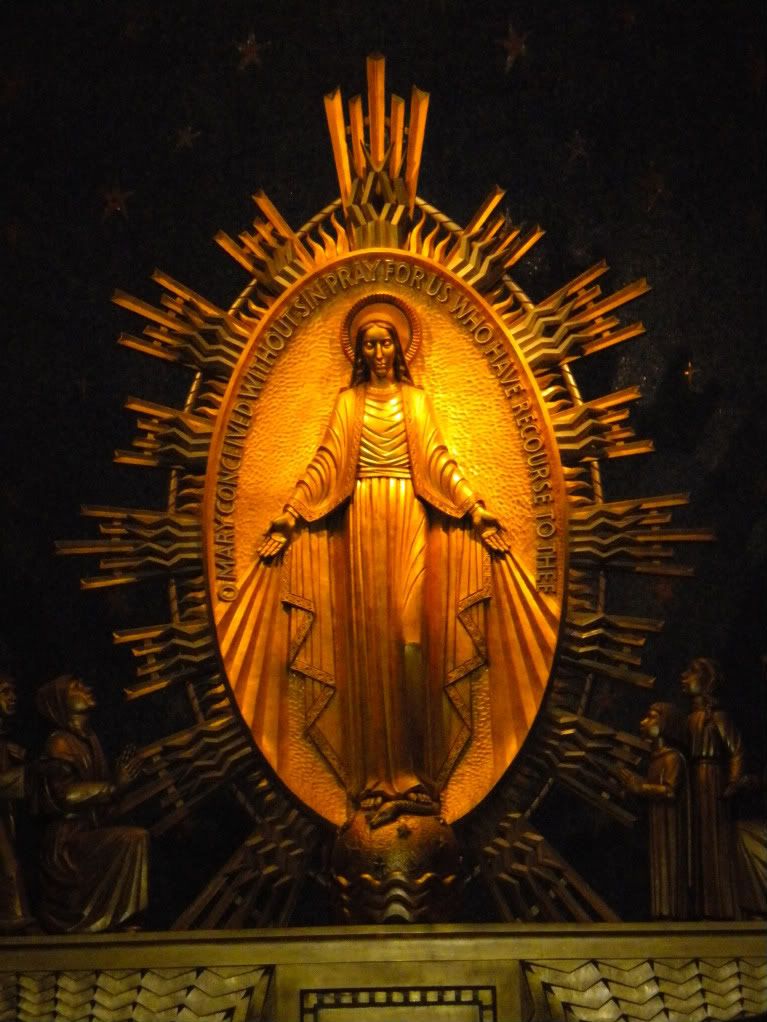
Immaculata-Patroness


 Joann Nelander Studio