
These remarks were delivered at Brigham Young University, January 23, as part of BYU’s on-going “Faith, Family and Society” lecture series.
“Henry Ford is often quoted as saying, “History is bunk.” That’s not quite accurate. What he actually told the Chicago Tribune in 1916 is this: “I wouldn’t give a nickel for all the history in the world. It means nothing to me. History is more or less bunk. It’s tradition. We don’t want tradition. We want to live in the present, and the only history that’s worth a tinker’s damn is the history we make today.”
It’s hard to imagine a better statement of the American spirit, or at least a certain strain in our national character. The Founders clearly understood the value of the past. Most were Christians. Nearly all were religious believers. They revered the memory of Roman law, architecture, and republican process. But they also very consciously intended to create a novus ordo seclorum—a “new order of the ages.”
And they succeeded. Tocqueville describes the difference between democracy and all the forms of political and social life that came before it as a gulf between “two distinct humanities.” Democratic man is very different from his ancestors—or so we’re led to believe. So it’s no surprise that Americans tend to be poor students of history. We enjoy nostalgia because it’s a kind of entertainment. But the real events of the real past come with annoying baggage. We can’t reinvent ourselves in the present if we’re dragging around a history of inconvenient duties and facts. The good news is that this is part of our genius. We innovate because we’re not crushed by the weight of our memories. The bad news is that it leads to forgetting things we need to remember. And amnesia is dangerous both for individuals and for nations.”
Read more: via The Great Charter at 800 | Charles J. Chaput | First Things.
religion and spirituality
All posts tagged religion and spirituality
.From the Mirror of Love by Saint Aelred, abbot
Christ, the model of brotherly love
The perfection of brotherly love lies in the love of one’s enemies. We can find no greater inspiration for this than grateful remembrance of the wonderful patience of Christ. He who is more fair than all the sons of men offered his fair face to be spat upon by sinful men; he allowed those eyes that rule the universe to be blindfolded by wicked men; he bared his back to the scourges; he submitted that head which strikes terror in principalities and powers to the sharpness of the thorns; he gave himself up to be mocked and reviled, and at the end endured the cross, the nails, the lance, the gall, the vinegar, remaining always gentle, meek and full of peace.
In short, he was led like a sheep to the slaughter, and like a lamb before the shearers he kept silent, and did not open his mouth.
Who could listen to that wonderful prayer, so full of warmth, of love, of unshakeable serenity—Father, forgive them—and hesitate to embrace his enemies with overflowing love? Father, he says,forgive them. Is any gentleness, any love, lacking in this prayer?
Yet he put into it something more. It was not enough to pray for them: he wanted also to make excuses for them.Father, forgive them, for they do not know what they are doing. They are great sinners, yes, but they have little judgment; therefore,Father, forgive them. They are nailing me to the cross, but they do not know who it is that they are nailing to the cross: if they had known, they would never have crucified the Lord of glory; therefore, Father, forgive them. They think it is a lawbreaker, an impostor claiming to be God, a seducer of the people. I have hidden my face from them, and they do not recognize my glory; therefore, Father, forgive them, for they do not know what they are doing.
If someone wishes to love himself he must not allow himself to be corrupted by indulging his sinful nature. If he wishes to resist the promptings of his sinful nature he must enlarge the whole horizon of his love to contemplate the loving gentleness of the humanity of the Lord. Further, if he wishes to savor the joy of brotherly love with greater perfection and delight, he must extend even to his enemies the embrace of true love.
But if he wishes to prevent this fire of divine love from growing cold because of injuries received, let him keep the eyes of his soul always fixed on the serene patience of his beloved Lord and Savior.
A man clothed in sin
Walked the long aisle
To stand before the Crucifix.
Long years,
No tears,
He came to say,
“You died for me,
And I don’t give a damn!”
The hardened before the Hallowed,
The clock running down,
Time spent and unreflected,
Deeds done and unrepentant.
Challenged to say the words,
He began,
“You died for me,
And I don’t give…”
Undaunted, he repeated,
“You died for me
And I don’t…..”
Gaze focused
On that bloodied Corpse,
Resolute, again, he began.
“You died for me…”
…….
“You died for me…”
“You died for me!”
Tears, tears,
Rivers of tears,
Years unspent,
And now in flood.
Miracles at the Red Sea,
Yet, none greater
Than the Passover,
One innocent Lamb,
Slain, and yet standing,
Lifted up,
Drawing thee.
© 2012 Joann Nelander
All rights reserved
May I burn like a candle
On the altar of God.
In the mystery of fire.
May I contemplate Your Presence.
In the flame that is Love.
We exist together.
The wax of my being is consumed,
In sacred transformation.
Enkindled, ignited and enflamed,
I Am sets me free.
Lover and beloved,
Be now All Holy Light.
copyright 2015 Joann Nelander
Joann Nelander
lionessblog.com
Jonah Goldberg took time to learn the unbiased, and actual history of the the Crusades and Inquisition periods unlike Obama whose trash talk betrayed his ignorance.
via Horse Pucky from Obama | National Review Online.
by Jonah Goldberg
“On Tuesday, the so-called Islamic State released a slickly produced video showing a Jordanian pilot being burned alive in a steel cage. On Wednesday, the United Nations issued a report detailing various “mass executions of boys, as well as reports of beheadings, crucifixions of children, and burying children alive” at the hands of the Islamic State.
And on Thursday, President Obama seized the opportunity of the National Prayer Breakfast to forthrightly criticize the “terrible deeds” . . . committed “in the name of Christ.”
“Humanity has been grappling with these questions throughout human history,” Obama said, referring to the ennobling aspects of religion as well as the tendency of people to “hijack” religions for murderous ends.
And lest we get on our high horse and think this is unique to some other place, remember that during the Crusades and the Inquisition, people committed terrible deeds in the name of Christ. In our home country, slavery and Jim Crow all too often was justified in the name of Christ.
Obama’s right. Terrible things have been done in the name of Christianity. I have yet to meet a Christian who denies this.
But, as odd as it may sound for a guy named Goldberg to point it out, the Inquisition and the Crusades aren’t the indictments Obama thinks they are. For starters, the Crusades — despite their terrible organized cruelties — were a defensive war.
“The Crusades could more accurately be described as a limited, belated and, in the last analysis, ineffectual response to the jihad — a failed attempt to recover by a Christian holy war what had been lost to a Muslim holy war,” writes Bernard Lewis, the greatest living English-language historian of Islam.
As for the Inquisition, it needs to be clarified that there was no single “Inquisition,” but many. And most were not particularly nefarious. For centuries, whenever the Catholic Church launched an inquiry or investigation, it mounted an “inquisition,” which means pretty much the same thing.
Historian Thomas Madden, director of the Center for Medieval and Renaissance Studies at Saint Louis University, writes that the “Inquisition was not born out of desire to crush diversity or oppress people; it was rather an attempt to stop unjust executions.”
In medieval Europe, heresy was a crime against the state, Madden explains. Local nobles, often greedy, illiterate, and eager to placate the mob, gleefully agreed to execute people accused of witchcraft or some other forms of heresy. By the 1100s, such accusations were causing grave injustices (in much the same way that apparatchiks in Communist countries would level charges of disloyalty in order to have rivals “disappeared”).
“The Catholic Church’s response to this problem was the Inquisition,” Madden explains, “first instituted by Pope Lucius III in 1184.”
I cannot defend everything done under the various Inquisitions — especially in Spain — because some of it was indefensible. But there’s a very important point to make here that transcends the scoring of easy, albeit deserved, points against Obama’s approach to Islamic extremism (which he will not call Islamic): Christianity, even in its most terrible days, even under the most corrupt popes, even during the most unjustifiable wars, was indisputably a force for the improvement of man.
Christianity ended greater barbarisms under pagan Rome. The church often fell short of its ideals — which all human things do — but its ideals were indisputably a great advance for humanity. Similarly, while some rationalized slavery and Jim Crow in the U.S. by invoking Christianity, it was ultimately the ideals of Christianity itself that dealt the fatal blow to those institutions. Just read any biography of Martin Luther King Jr. if you don’t believe me.
When Obama alludes to the evils of medieval Christianity, he fails to acknowledge the key word: “medieval.” What made medieval Christianity backward wasn’t Christianity but medievalism.
It is perverse that Obama feels compelled to lecture the West about not getting too judgmental on our “high horse” over radical Islam’s medieval barbarism in 2015 because of Christianity’s medieval barbarism in 1215.
It’s also insipidly hypocritical. President Obama can’t bring himself to call the Islamic State “Islamic,” but he’s happy to offer a sermon about Christianity’s alleged crimes at the beginning of the last millennium.
We are all descended from cavemen who broke the skulls of their enemies with rocks for fun or profit. But that hardly mitigates the crimes of a man who does the same thing today. I see no problem judging the behavior of the Islamic State and its apologists from the vantage point of the West’s high horse, because we’ve earned the right to sit in that saddle.”
“The image of Our Lady of Guadalupe has been the subject of numerous technical studies.”
Blog: Infallible Catholic
Post: Miraculous Image of Our Lady of Guadalupe
Link: http://infallible-catholic.blogspot.com/2012/04/miraculous-image-of-our-lady-of.html
“The image of Our Lady of Guadalupe has been the subject of numerous technical studies.”
Blog: Infallible Catholic
Post: Miraculous Image of Our Lady of Guadalupe
Link: http://infallible-catholic.blogspot.com/2012/04/miraculous-image-of-our-lady-of.html
,
Luke 2, 22-40 “When the days were completed for their purification according to the law of Moses, they took him up to Jerusalem to present him to the Lord, just as it is written in the law of the Lord, “Every male that opens the womb shall be consecrated to the Lord, and to offer the sacrifice of “a pair of turtledoves or two young pigeons,” in accordance with the dictate in the law of the Lord. Now there was a man in Jerusalem whose name was Simeon. This man was righteous and devout, awaiting the consolation of Israel,and the holy Spirit was upon him. It had been revealed to him by the holy Spirit that he should not see death before he had seen the Messiah of the Lord. He came in the Spirit into the temple; and when the parents brought in the child Jesus to perform the custom of the law in regard to him, 28he took him into his arms and blessed God, saying:“Now, Master, you may let your servant go in peace, according to your word, for my eyes have seen your salvation,which you prepared in sight of all the peoples,a light for revelation to the Gentiles, and glory for your people Israel.”
The child’s father and mother were amazed at what was said about him; and Simeon blessed them and said to Mary his mother, “Behold, this child is destined for the fall and rise of many in Israel, and to be a sign that will be contradicted (and you yourself a sword will pierce) so that the thoughts of many hearts may be revealed.” There was also a prophetess, Anna, the daughter of Phanuel, of the tribe of Asher. She was advanced in years, having lived seven years with her husband after her marriage, and then as a widow until she was eighty-four. She never left the temple, but worshiped night and day with fasting and prayer. And coming forward at that very time, she gave thanks to God and spoke about the child to all who were awaiting the redemption of Jerusalem.
When they had fulfilled all the prescriptions of the law of the Lord, they returned to Galilee, to their own town of Nazareth. The child grew and became strong, filled with wisdom; and the favor of God was upon him.”
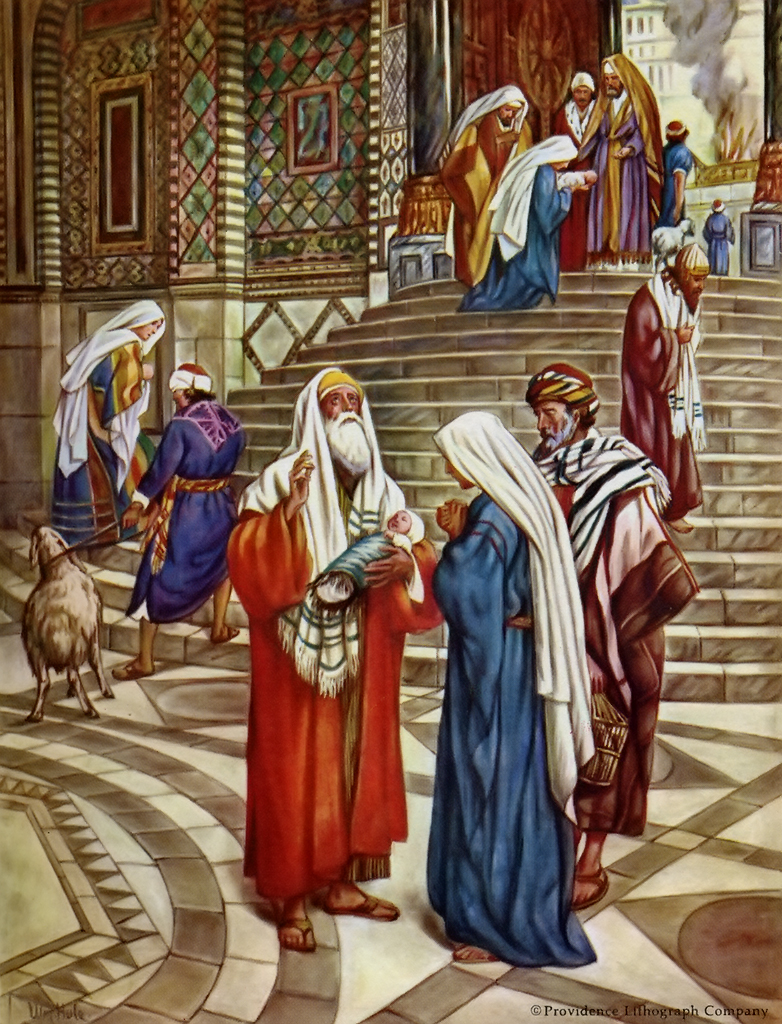
—AND TO VENERABLE MOTHER MARY OF AGREDA: “My daughter, the doctrine and example contained in this Mystery will teach thee to strive after the constancy and expansion of heart by which thou mayest prepare thyself to accept blessings and adversity, the sweet and the bitter, with equanimity. “How persistently the human heart forgets that its Teacher and Master has first accepted sufferings, and has honored and sanctified them in His own Person! “Remember the sorrow that pierced my heart at the prophecies of Simeon, and how I remained in peace and tranquility, even though my heart and soul were transfixed by a sword of pain. “Seek ever to preserve inward peace. “Full of trust in me, whenever tribulation comes over thee, fervently exclaim: “‘ The Lord is my light and my salvation: whom shall I fear?’”
THE BLESSED VIRGIN SAID TO ST. BRIDGET OF SWEDEN: “I did not need purification, like other women, because my Son who was born of me, made me clean. Nevertheless, that the Law and the prophecies might be fulfilled, I chose to live according to the Law. Nor did I live like worldly parents, but humbly conversed with the humble. Nor did I wish to show anything extraordinary in me, but loved whatever was humble. “On that day (of the Purification) my pain was increased. For though by divine inspiration I knew that my Son was to suffer, yet this grief pierced my heart more keenly at Simeon’s words. And until I was assumed in body and soul to Heaven, this grief never left my heart, although it was tempered by the consolation of the Spirit of God. Let not, then, this grief leave thy heart, for without tribulation few would reach Heaven.”
Brown, Raphael (2011-02-28). The Life of Mary As Seen by the Mystics (p. 132). TAN Books. Kindle Edition.

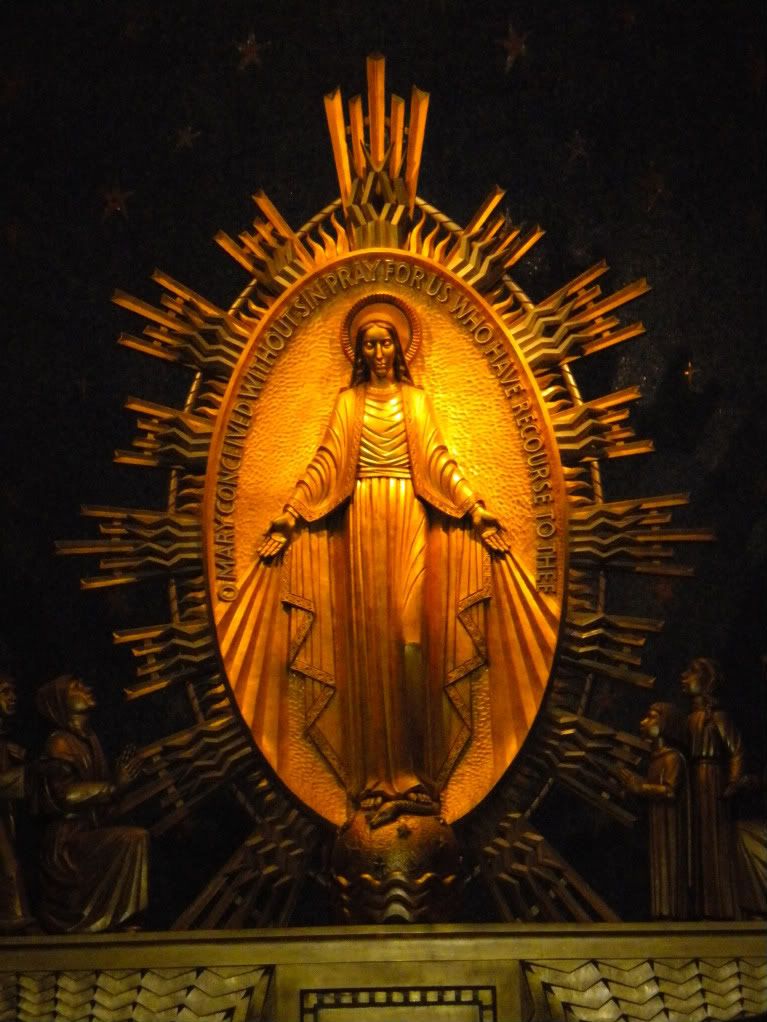
Your Light, My Light
As the dark of night
Makes way for Your Sun,
Open our eyes to New Day.
To the Temple of our God,
Your Light is carried forth,
In the arms of the Virgin.
Pure Mother of Nations,
May we, too, be bathed,
And come up from the waters,
Open to Light and Life.
copyright 2015 Joann Nelander


 Joann Nelander Studio