Doctor Delivers Baby Still in Amniotic Sac, Would Abortion be OK? | LifeNews.com.


For the meat of the video start at 5:00 – earlier parts present course of available books on the subject matter.
Is Religion the Cause of Most Wars? | Rabbi Alan Lurie.
“There are many common misconceptions about religion that are often taken as unquestioned facts, such as the idea that religious people are inherently anti-science, that a literal reading of holy texts is the “true” religious stance, that faith is incompatible with reason, and that all religions claim to posses sole and absolute truth.
While all these ideas are true for a minority of the population, they do not describe normative religious beliefs and practices for the majority of believers. It is understandable that these misconceptions persist, though, because they come from the loudest voices on the extremes, and like other polarizing positions in politics and culture are simplistic ideas that promote easy “us vs. them” thinking. But there is one common misconception about religion that is voiced often and consistently as an obvious truth — often by educated, thoughtful people –that is just not factually true: The idea that religion has been the cause of most wars.
In his hilarious analysis of The 10 Commandments, George Carlin said to loud applause, “More people have been killed in the name of God than for any other reason,” and many take this idea as an historical fact. When I hear someone state that religion has caused most wars, though, I will often and ask the person to name these wars. The response is typically, “Come on! The Crusades, The Inquisition, Northern Ireland, the Middle East, 9/11. Need I name more?”
Well, yes, we do need to name more, because while clearly there were wars that had religion as the prime cause, an objective look at history reveals that those killed in the name of religion have, in fact, been a tiny fraction in the bloody history of human conflict. In their recently published book, “Encyclopedia of Wars,” authors Charles Phillips and Alan Axelrod document the history of recorded warfare, and from their list of 1763 wars only 123 have been classified to involve a religious cause, accounting for less than 7 percent of all wars and less than 2 percent of all people killed in warfare. While, for example, it is estimated that approximately one to three million people were tragically killed in the Crusades, and perhaps 3,000 in the Inquisition, nearly 35 million soldiers and civilians died in the senseless, and secular, slaughter of World War 1 alone.
History simply does not support the hypothesis that religion is the major cause of conflict. The wars of the ancient world were rarely, if ever, based on religion. These wars were for territorial conquest, to control borders, secure trade routes, or respond to an internal challenge to political authority. In fact, the ancient conquerors, whether Egyptian, Babylonian, Persian, Greek, or Roman, openly welcomed the religious beliefs of those they conquered, and often added the new gods to their own pantheon.
Medieval and Renaissance wars were also typically about control and wealth as city-states vied for power, often with the support, but rarely instigation, of the Church. And the Mongol Asian rampage, which is thought to have killed nearly 30 million people, had no religious component whatsoever.
Most modern wars, including the Napoleonic Campaign, the American Revolution, the French Revolution, the American Civil War, World War I, the Russia Revolution, World War II, and the conflicts in Korea and Vietnam, were not religious in nature or cause. While religious groups have been specifically targeted (most notably in World War II), to claim that religion was the cause is to blame the victim and to misunderstand the perpetrators’ motives, which were nationalistic and ethnic, not religious.
Similarly, the vast numbers of genocides (those killed in ethic cleanses, purges, etc. that are not connected to a declared war) are not based on religion. It’s estimated that over 160 million civilians were killed in genocides in the 20th century alone, with nearly 100 million killed by the Communist states of USSR and China. While some claim that Communism itself is a “state religion” — because it has an absolute dictator whose word is law and a “holy book” of unchallenged rules — such a claim simply equates “religion” with the human desire for power, conformance, and control, making any distinctions with other human institutions meaningless”
Read more Is Religion the Cause of Most Wars? | Rabbi Alan Lurie.
Mother Mary,
You were with Jesus
From the instant
Of His Incarnation.
With your “Fiat”,
The Promise
Became a Man,
Dwelling with you,
In profound peace
And humility.
It was you
Who knew
This first intimacy,
Who cherished and adored.
Who waited upon Him,
With heart,
And mind,
And body.
The only eyes
That could see Him
At this tender age,
Were yours,
As you gazed on Him
With the eyes
Of your intellect
And soul.
An inward glance
Set your Immaculate Heart ablaze,
As you became,
Home and hearth,
And throne,
For a Child of one cell,
Growing and destined
To rule the world,
As He had reigned
From eternity.
A Man like no other
And, yet,
Intimately,
One with all.
Open our eyes
To your Son.
With the Centurion,
Who presided
Over the Crucifixion
Of the Christ,
And opened His Side.
End our idolatry,
So we, too, cry
“Truly, this was the Son of God!”
Mother Mary,
Behold your Son
In me.
Prepare me to be
Home and hearth
And throne,
For Christ alone.
©2012 Joann Nelander
Old year passes,
Becoming yet another ghost,
Withered as leaves,
Crumbled, and carried aloft
By winter winds,
Too soon scattered
By the breezes of Time.
Is it truly spent,
Dead and long forgotten,
Living but in memory?
May not reflection
Call it from the grave,
Uncover the gain
Hold it fast
To live again?
How has its many waters
Blessed thee and me,
As sacred signs?
Will it, as muse, retain a power
For its having been,
And then no more?
What saints and angels
Sent my way,
Colored its day?
In sorrow,
Who came to hold my hand?
In joy,
Who shared my hearth?
Were there hugs, and smiles,
And laughter to tilt the scale of grief?
Can kisses and embraces be resurrected,
That fires of love be stoked
To warm and blaze anew?
Has my thanksgivings
Been recorded in the pyre,
Written in the embers now glowing
As tiger eyes flashing from the ash.
Years come, doomed , too soon to go,
But let them not hurry
To a crypt without a wake.
Drink the happy wine of memory,
Sip, as the seasons turn.
Contemplate and savor
The seasons of your soul.
©2011 Joann Nelander
FROM THE EUCHARISTICMEDITATIONS OF THE
CURÉ D’ARS:“O my soul, how great thou art since only a God can satisfy thee! The food of the soul is the
Body and Blood of a God! What beautiful nourishment! The soul can only feed on a God! No
other than God can suffice. Only God can satisfy its hunger. It needs God absolutely.
O my soul, bless this God who is so magnificent. Come often to this divine banquet to satiate
thyself with justice and holiness. Those who refuse to sit down here or who partake of it only at
long intervals, condemn themselves to certain death or to weakness, because one cannot live
without food nor enjoy vigorous health without eating frequently.” Cure of Ars
H/T Artist – Sr. Grace Remington, OCSO
This painting is so consoling, I just have to share it again since Advent brings us closer and closer to the precious moment of our Savior’s birth. He comes to save Fallen Man, and with such a gentle hand.
*Notice the feet in this painting.

Crayon and pencil by Sr. Grace Remington, OCSO
Copyright 2005, Sisters of the Mississippi Abbey
podcast –http://amongwomenpodcast.com/guest/sr-grace-remington-ocso/
Clinging, clinging to You,
As a leaf clasping the vine
With mouth pressed
And soul hungry,
Receiving in its will
Sustenance and vigor.
Stress, season, time,
And the tempters three,
World, Devil and fleshy me,
Turn, test and try resolve.
Clinging, I cling,
Clasping fast,
For only the glue of love
Suffice as bond,
To quell and conquer,
The wanton, the unruly.
For the Conqueror abides in me,
I cling to the Almighty Three.
Copyright 2011 Joann Nelander
“What is temptation? Temptation is the work of Satan to drag you to Hell. And Satan can read you like a book and play you like piano. Do not exaggerate his power, but do not underestimate it either.
Some of his subtlest work is done in the area of religious observance. There, he can cloak himself quite easily in the lamb’s clothing of piety, but, wolf that he really is, distort it, either through excess or defect, thereby destroying you with what is good. Beware what some spiritual writers call the “traps of the pious.” Consider some examples:
He can discourage you with prayer by saying, “If only you would pray a little longer, God will give you what you seek.” But the deception is that if we can pray a little longer, then we can never have prayed enough. Thus though we pray, we only feel guilty and inadequate. And since we can never have prayed “enough,” prayer increasingly turns into a burdensome task; God becomes a cruel taskmaster demanding longer and more precise prayers. Or prayer becomes a superstitious endeavor whose outcome we somehow control by the length and type of our prayers. Jesus counsels us that the Father knows what we need and that we should not think that merely multiple words and pious actions are necessary. We may need to persevere in prayer over time, but God is not a cruel tyrant demanding endless incantations.
Satan can take the beautiful practice of praying the rosary, or attending daily Mass, or other devotions and slowly incite in us a feeling of smug superiority, elitism, or pride. Gradually, others are thought to be less devout, even in error, because they do not do or observe what is optional or encouraged but not required. What is beautiful and holy is thus employed to incite ever-growing pride and cynicism. A most extreme form of this comes from those who take the beautiful and powerful devotion to our Lady of Fatima and allow Satan to set them against even the Pope and all the world’s bishops by claiming that they failed, either ineptly or willfully, to properly consecrate Russia. And thus one of our most beautiful and informative apparitions can engender in some people distrust of the Church and disunity from her, from multiple popes, and even from Sister Lucia herself. It is an astonishingly crafty work of the evil one to take what is good and religious and corrupt it in the minds of some.
Satan can also take what IS required and turn it into a kind of religious minimalism, a way of keeping God at a distance. And thus he tempts some souls with the notion that Sunday Mass, a little something in the collection plate, and a few rushed prayers are the end of religion rather than the beginning of it. Such observances become a way of “checking off the God-box” and being done with God for the week, rather than a foundation on which to build a beautiful and ever-deepening relationship of love with God. Such minimal practices become a form of “God-control” for those tempted in this way; it is as if to say, “I’ve done what I am supposed to do, now God and the Church have to leave me alone. God also needs to take care me now since I’ve done what I’m required to do.” And thus the Church’s beautiful laws and the requirements describing the basic duties or foundation for a deepening relationship with God, become a kind of “separation agreement,” insisting on very strict visiting hours and specifying who gets what.
Satan can take religious zeal and corrupt it into harsh and uncharitable zealotry. He can take a love for the beauty of the Liturgy, ancient or new, and turn it into a persnickety insistence on exactly the right ingredients, at the expense of charity and at the cost of ridicule, false superiority, and disunity. And thus, charity thrust aside, we say, “Just make sure you celebrate the liturgy the way I like it. Anyone who doesn’t like what I like is antiquarian, a knave, or an uncouth troglodyte and must obviously hate the Church that I love so beautifully …”


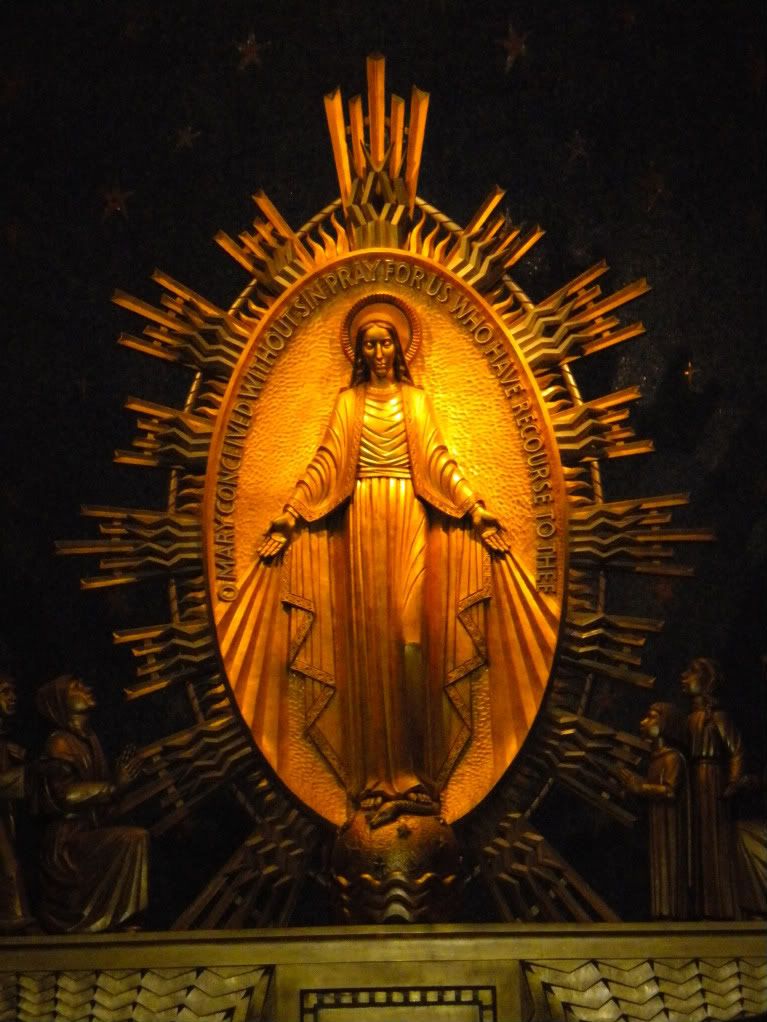
Immaculata-Patroness


 Joann Nelander Studio